Nunc Cognosco Ex Parte 2

Here is my second post of mostly links to what I’ve found intriguing, compelling or convicting lately.  Perhaps you’ll find something of interest in what I’ve been reading online and in print!

If you pay attention to the sounds and rhythms of Caledonia and Hibernia, you’ll enjoy reading Twelve Letters That Didn’t Make the Alphabet .  I found it via Homeschoolenrichment.com newsletter. 

One Hundred Reasons -  American Thinker’s Daren Jonescu has been on a roll lately, first with American Education:  Rotting from the Inside, and now with 100 Reasons to Abandon Public Education Now.

Are your children in danger or dangerous? 

“In the ancient world, the city gates were not only where defenders of a city would face invaders, but they were also what we would call the public square.

Blessed was the man who had sons who stand with him in a crucial showdown at the city council. They were shoulder to shoulder behind him, and not over on the other side.

Neither were they all at home playing video games or out back smoking in the alley.”

Mr. Garner and I are, sadly, too late for a quiver full, but there is still much to glean from this article on Christian parenting by Doug Wilson entitled, Raising Arrow Children. 

Getting a job – might be easier in the future for homeschoolers:  Educating Thinkers.  By way ofBeautiful Feet Books Blog -

Brandy at Afterthoughts posted my Latin series on her wonderful blog and my hits climbed to the sky!  Thanks Brandy!  I’m also grateful for her Stupendous Sunday posts which always, always, always get me thinking!  In one in particular:  How to Matter, by Andrew Kern for the Circe Institute,  I particularly liked this bit:

“Instead of confidently showing what a school steeped in grace would look like, we conform to the world and make ourselves a little pathetic.

How, after all, will nourishing a child’s soul on the true, the good, and the beautiful help a child get into college?

What we seem not to ask is why a parent would want to send a child to a college for which the true, the good, and the beautiful didn’t help prepare him?”

On the Bookshelf

Mr. Garner recently read Amity Schlae’s look back at the depression called The Forgotten Man.  Get ready to have the progressive take on events you’ve been taught all these years turned upside down.  We are looking forward to reading her biography of Coolidge, but if you need to catch up, you can read this bit from Hillsdale College Imprimis. 

My brain has been burned recently reading Saving Leonardo:  A Call to Resist the Secular Assault on Mind, Morals & Meaning, by L’Abri Fellowship, and Francis A. Schaeffer Scholar Nancy Pearcey.   There is a great deal to absorb, and at points I was tempted to thrust it away, as I slogged through the sections on philosophy and art.  But I was chastened by Mortimer Adler (How to Read a Book) to continue on and give it “the kind of reading that a book which challenges your understanding deserves.”  At the same time for my personal fiction I read  Quo Vadis, by Henryk Sienkiwicz.  I was amazed that Norfolk Public Library had a copy.  Usually, anything classic, or remotely Christian, requires an Interlibrary Loan.  Sad really.

Sanctity of Life

I have admired Ryan Bomberger’s articulate voice for life for quite a while, but watching him fence with this faux journalist was a delight. Interestingly he is being sued by the NAACP. 

The  Gosnell trial has been appalling.  Worse has been the media’s cover-up.  Lots of reasons why:

The news media in America simply will not tell you what they don’t want you to know, or what they do not want to face – The Banality of Bias

LifeNews covered the trial and it is an appalling collection of articles.  Here is a summary article ghoulishly titled “All American Horror Story.”

World writer Andree Seu Peterson has also been covering the trial, her collection of articles might be easier to read, but I make no promises.  The truth is horrific, and Andree looks at trial through the worldview given her by our Creator God, so her observations are appalling on a deeper level.  This is an interesting quote:

“The pro-choice media had their own challenge. They had to justify to themselves being no-shows at a trial that contained all the ingredients they usually salivate over—murder, race, lack of government regulation, the plight of disadvantaged women. Gosnell is actually one of their own—an abortion-rights champion. In another time, in another place, they would have made him a hero: “African-American doctor forgoes big salaries to serve the underserved of the inner city.” But instead they had to cut him loose because he had become a liability. He drew the spotlight on details that should never see the sun.”

And politically speaking:  Unspeakable Things Unspoken

Finally, for my former “faith family” at the UMC.  A problem of Logic for Joe Biden and the Pro-Abortion Religious Left.

Family

Manhattan Declaration Amicus Brief for the Defense of Marriage Act – Read the brief (it’s brief) You should know why family matters.  You should know why it is important to kindly but decisively defend marriage between a man and a woman.    If you don’t understand why this matters, see the next article:

What has become painfully evident is that many of those who brought same-sex marriage to Canada have no respect for freedom of conscience and no intention of tolerating contrary opinion, whether that opinion is shaped by religious or by secular belief…Canadian Crackdown. The Canadian litany of pain, firings, and social and political polarization and extremism is extraordinary and lamentable, and we haven’t even begun to experience the mid- and long-term results of this mammoth social experiment.

Society

Memoria Press publishes our Latin Curriculum, among many other subjects in the Classical Education model.  Their recent newsletter included this link to a video of Martin Cothran speaking on the topic, “Saving Western Civilization One Student at at Time.”  And yes, they really do think that way.  It’s about an hour, and if you’re not familiar with the history of education in America this past century, he gives a quick overview.  He concludes with a quote from T.S. Eliot, that I find startlingly accurate, yet strangely hope-filled, certainly purposeful:

“The world is trying to experiment with attempting to form a civilized but non-Christian mentality.  The experiment will fail; but we must be very patient in awaiting its collapse;  meanwhile redeeming the time: so that the faith may be preserved alive through the dark ages before us; to renew and rebuild civilization and save the world from suicide.”

Second Amendment

Another articulate defense of the Second Amendment, this time from a legal immigrant.

http://www.theblaze.com/stories/2013/01/31/legal-immigrants-must-watch-testimony-against-gun-control-in-america/

For those who enjoyed the historically inspired and reasoned approach to gun ownership on Afterthoughts linked to in Nunc Cognosco Ex Parte 1 – here are links to a few more installments:
Understanding Guns in America:  James Madison’s Angel Problem
Understanding Guns in America: On Amendments and Ratification
Understanding Guns in America: Res Publica, the Nature of a Republic

I’ve been accumulating this list for a while, adding and subtracting over the months.  Originally, it was to be a weekly or monthly listing.  But aren’t all plans subject to the reality of living life! 

The post title I’ve chosen for these sorts of posts is obscure on purpose.  Meaning “now I know in part,” the phrase is found in Paul’s first letter to the Corinthians towards the end of chapter 13.  It refers to the fact that our knowledge of God and His mysteries unfolds only in part during our human existence.  We must wait for full disclosure.  This should instill a great deal of humility in our thinking…

Leave a Comment

Filed under Nunc Cognosco Ex Parte, What's Going On?

F is for Fun and Flowers at Norfolk Botanical Gardens

Beginning each April, the Norfolk Botanical Gardens open up their extensive grounds to bicyclists three nights of the week from 4 -7 pm throughout the Summer.   We always keep a membership to the Norfolk Botanical Gardens, but never use it enough.  Mr. Garner and I would occasionally have a date at the NBG,  “sweet lovers love the Spring” and all of that.  We had a picnic one year for Mother’s Day which was wonderful!  Over the years we would make it out to the gardens, once, maybe twice a summer to walk or ride bikes along the trails, over the bridges and around the slight hills (the only ones in our flat coastal area!), climb the NATO tower, stretch out on a blanket in the Renaissance Court,  and simply enjoy the garden.  We loved it, and would always ask ourselves, “Why don’t we do this more often?”

This year Mr. Garner issued a proclamation and scheduled Weekly Wednesday Bike Nights at NBG and so far it has been the highlight of our Spring!

On each weekly visit we find something new in bloom, more colors and textures along the path, a shift in the landscape as perennials emerge and bare branches become green, and always a heavenly scent on the breeze.

IMAG3820

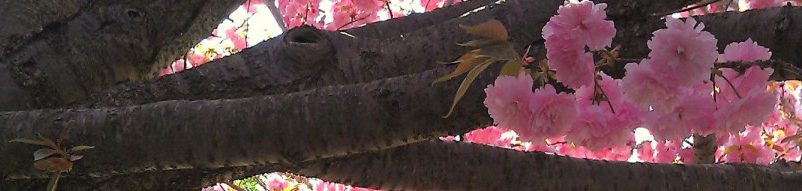
The first week we were entranced with an enormous Weeping Cherry tree in the Flowering Arboretum.  Among the trees mostly bare, this tall tree with long pink tresses beckoned us closer.  The slightly lemony scent of Winter Daphne in the Winter Garden also got us off of our bikes for a sniff.  Daffodils scattered yellow in the fields, while others added precision along the paths.  The tree branches were studded with buds, thick and fuzzy.  The Tulip Magnolia trees offered elegant pink cups.  The Jasmine twined around the pergolas in the Butterfly Garden.

The next week we simply could not fill our lungs enough with the glorious clean scent of blooming Crab Apple, and we noticed that more of the trees in the Flowering Arboretum were clothed in gauzy green as leaves started stretching out for the sunshine. A riot of bulbs were in bloom, tulip, hyacinth, and more in the Sunken Garden and Circle Gardens.

IMAG3828

The following week we found ourselves in love with an enormous Japanese Cherry.  By parking the bike and stepping under the branches one could enter into a fairy bower where dappled sunlight filtered through a million or more fluffy pink cherry blossoms.   We also found a Dove Tree!  Have you ever heard of a Dove Tree?  It has the loveliest white flowers that look like – Doves! The wisteria was covered with bees feasting on nectar hidden in plump purple blossoms.  Further along, large clusters of tightly furled and surprisingly fuzzy ferns in the Fern Glade offered a whimsical and slightly Seussian feel to the day!  And along the Border Garden walkway the pom-pom blossoms of Viburnum continued the theme.

Then the Azaleas started blooming!  I should mention that the Norfolk Botanical Gardens were first established as the Azalea Gardens.  There are likely thousands of Azalea bushes throughout the garden.  Some neon bright, some softer, some with large formosa blossoms other with tiny blossom clusters.  My favorite fuschia-purple variety smells fantastic – we have one on the side of our house.  In the Enchanted Forest at the NBG, they line a large section of the shady path, and bring new meaning to the phrase “a breath of fresh air.”

Last week the Sarah Lee Baker Perennial Garden and Border Garden walkway beds were filling in with Shasta Daisy, Fox Glove, several varieties of Iris and Peonies, and we were delighted to spot a bunny leaping across the path to a hedge.  The orderly acres of roses in the extensive Bicentennial Rose Garden are offering a profusion of color and scent.

We’ve seen brides being photographed, flocks of children with mom and dad, and a few regulars; an elderly gent on his regular evening walk, a couple who know every nook and cranny of the garden,  a teen and her mom.  As the weather warms up, there are perhaps more people than at first.  But there are long stretches where it seems we have the entire glorious garden to ourselves, and surrounded by beauty and fragrance it feels somewhat sacred.  There are moments when the softening sunlight casts a holy golden glow through branches, and gilds the edges of flowers.  And yet, it feels a little bit like home…

I can’t wait to see what will be blooming next!

God’s Garden, by Robert Frost

God made a beautous garden
With lovely flowers strown,
But one straight, narrow pathway
That was not overgrown.
And to this beauteous garden
He brought mankind to live,
And said: “To you, my children,
These lovely flowers I give.
Prune ye my vines and fig trees,
With care my flowerets tend,
But keep the pathway open
Your home is at the end.”

Then came another master,
Who did not love mankind,
And planted on the pathway
Gold flowers for them to find.
And mankind saw the bright flowers,
That, glitt’ring in the sun,
Quite hid the thorns of av’rice
That poison blood and bone;
And far off many wandered,
And when life’s night came on,
They still were seeking gold flowers,
Lost, helpless and alone.

O, cease to heed the glamour
That blinds your foolish eyes,
Look upward to the glitter
Of stars in God’s clear skies.
Their ways are pure and harmless
And will not lead astray,
Bid aid your erring footsteps
To keep the narrow way.
And when the sun shines brightly
Tend flowers that God has given
And keep the pathway open
That leads you on to heaven.

This post was inspired by Blogging through the Alphabet with Marcy over at Ben and Me.  I’m also sharing this over at HSPA Blog and Tell Show Us Your Flowers.  And it might make it into Barb’s Outdoor Nature Hour Blog Carnival at Handbook of Nature Study!

As always, thanks for stopping by – we love visitors!

bloggingalphabetnewsmBlogAndTell-May-2013

3 Comments

Filed under Nature Study and Science, What's Going On?

E is for Ephesians

I can only say that I went for years without knowing where Ephesus was located, or caring.

For years it was one of those smaller books in the back of the New Testament after Acts and Romans, in the general vicinity of Corinthians and Thessalonians and Galatians and Philippians, and I didn’t know where those ancient towns were either.  My knowledge of book placement in the  Bible was iffy.  My understanding of Biblical geography was laughable.

Likewise, the content of Ephesians was a mystery.  I might have remembered it was an epistle, and perhaps known it was from Paul since he wrote lots of letters to strange cities.  But I was clueless regarding many of the key passages that now have great significance in our homeschool.

I’m not alone.  Isn’t it amazing how Biblically illiterate church people are today?

Since we were parked for a while in the period of the Roman Empire’s blood-spattered transition from pagan to Christian, it made sense to read the Epistles during our family Bible reading.  Terri Johnson’s Map Trek book has been a helpful addition throughout our Ancient History studies, and I was delighted to see a map of the Journeys of Paul included!   So, in addition to reading the Epistles we have been mapping the locations of all of the early church cities.

Journeys of Paul Map Trek Map

Journeys of Paul Map Trek Map

If you don’t know, Ephesus was a large, wealthy port city of vast importance to trade.  Originally a Greek colony of Athens, the city was situated between two rivers that emptied into the Mediterranean on the west coast of Asia Minor, or modern-day Turkey.  It was a bastion of Greek culture and finance while it endured the ebb and flow of an array of empires, the Persians, the Greeks, the Pontic Greeks, the Seleucid Greeks, and the Romans.  Sacked by the Goths, and again later by Arab caliphs, while enduring an earthquake and the constant silting of its harbors, Ephesus struggled along until it was finally abandoned in the fifteenth century.   The ruins of Ephesus are no longer on the Mediterranean coast,  they are now further inland due to a millennia of silt deposits from the adjacent rivers.

Reckoned to be over a thousand years old by the time the apostle Paul visited, and home to one of the Seven Wonders of the World, the Artemis temple, Ephesus was not only a successful, wealthy and populous city, it was exceedingly corrupt, with established demon, spirit and mystery religions, Artemis and Asklepios cult worship, and bathed in blood from the coliseum “games.”  Pagan children were regularly aborted, and those children who made it to birth, if girls, were regularly exposed (infanticide).  Over half of the population were slaves, and non slaves were often so poor that they would volunteer for gladiator games in order to have food, and bedding, for a while anyway.

Ruins at Ephesus

Ruins at Ephesus

At the same time that we are reading through the Epistles, Grace and I are reading through the second half of Famous Men of Rome in History, (Nero, Caligula, Titus, Trajan and such) and I’m pre-reading Sketches of Church History from AD 33 to Reformation by James Craigie Robertson, and Saints and Heroes to the End of the Middle Ages by George Hodges, and slogging through Quo Vadis: a narrative of the time of Nero, by Henryk Sienkiewicz (translated by Jeremiah Curtin) for my personal fiction reading – all of which makes for rather interesting contrasts.   The pathetic lack of stamina and witness in America’s mainline protestant churches on key social issues springs to mind, and is appallingly cowardly when considered next to say Polycarp of Smyrna, Athanasius of Alexandria, or even Youcef Nadarkhani.  Many of our puny pastors grow pale with terror at the idea of bad press resulting from a Christ-obedient stance on abortion or marriage.  Clearly they wouldn’t have been able to stand firm facing down a lion or the lighting design in Nero’s garden.   I suppose it’s something we should all think about.

To further embed the geography and give us sense of the challenges faced by church planters, particularly those in the First Century,  Mr. Garner went into his extensive game closet and pulled out his copy of the Journeys of Paul game.  It’s a pretty game, with a large map, and colorful cards, the board is in the header of this post (if you click the title of the post).  We all enjoyed working against the forces of wickedness as we strove to establish and nurture our church plants while dealing with shipwrecks, bad weather, obnoxious pagan dissent and other obstacles.  To get a sense of the dangers have a look at 2 Corinthians 11:22-33. 

On a lighter note, we were delighted to see that the history series “Drive Thru History” , previously outside our budgetary constraints, was streaming on Netflix so we watched all of the available episodes.  Although we rolled our eyes with impatience at the obligatory driving scenes, and the history is not in-depth, we did appreciate being able to see the ruins of Ephesus, Rome, Athens and many other sites of the Classical world, which combined with our other activities, added to our understanding of the early church.

Last year we memorized the Armor of God section from Ephesians using an Oh-So-Catchy-Song (really!) from the Harrow Family Sing the Word CDs that Sonlight sells.  In our reading this year I’ve found a few more stirring passages that we will use for copywork, and possibly memory work.   We really like this free printable illustrating the Full Armor of God (for young ladies!) from Nadene who blogs about homeschooling from her farm in South Africa and is a fabulous artist as well.

Finally, this reading of Ephesians 6:-17 by Maggie’s granddaughter…

bloggingalphabetnewsmThis post was prepared (weeks ago) for Blogging through the Alphabet with Marci over at Ben and Me.  I think they’re on the Letter H or something, but it seemed a shame to waste it! 

Leave a Comment

Filed under Homeschool Happenings, What's Going On?

D is for Didn’t Get it Done

bloggingalphabetnewsmIf you follow the Goings On of the Garners at all (Hi Dad!) you’ll have noticed that as a sort of writing prompt exercise, I started Blogging through the Alphabet with Marcy over at Ben and Me.  I had tried this before back in the fall, and it yielded about 4 posts before I gave up.  I prepared A is for Astronomy,  but I missed the deadline for “B.”  I was pleased with  C is for Commonplace Book and D is for Dvorak.  I was less excited about E, and F had me completely flummoxed, so I didn’t blog those letters.  I managed G is for Great Falls, but missed H,  I and J.  So I let it go, because to continue when I had missed all of those letters, two of which are vowels, seemed very incomplete.

When Marcy started over again, (she had blogged all 26 alphabet letters!) I decided to try it again, and wondered how far I would get.  This time I got to D and Didn’t Get It  Done.

I had quite a few ideas – D is for Dust.  This one would have been a picture post!  I thought about D is for Doric, but felt that Ionic and Corinthian should have their due so that will be coming later in a post, G is for Greek Architecture…(surely the anticipation is building!)  I considered D is for Doves (we have some new baby doves visiting our feeder), D is for Ducks (we’ll soon have some baby ducks visiting, assuming I’m a good judge of Mallard mating behavior), D is for Dill, Dickens, Domes (more architecture), Discs (as in Ultimate Frisbee), and Drill (a potential Latin Lovers post) As you can tell I had lots of choices but I didn’t get it done.

I did have a great weekend with Mr. Garner and our American Heritage Girl at the Family Camp Out at Northwest River Park!  Mr. Garner showed us girls how to put up our tent, and how to build a fire in the fire pit.  He fixed us up a wonderful dinner of Grilled Chicken, Green Beans and Baked Potatoes in the coals!  We sat out by the fire and looked up at bright, sparkling stars in a dark blue sky, savored the crackling warmth and listened to the fireside antics of the young children in neighboring tents.  The giggles and parental remonstrances slowly quieted as bedtimes came and went, and the sounds shifted to an occasional dog bark, the fall of a log on the fire, a shower of sparks, and the soughing of the wind advancing through tall swaying trees.

Morning brought hot coffee (Okay, it was Folgers instant, but it was good and hot!) fried eggs, sausage links, and blueberry muffins tucked inside orange peel halves, wrapped in foil and cooked in the coals! Delicious!  After a morning gathering with other families working through fun bonding and problem solving activities, GraceNotes scampered off to complete a few items on her camping badge and Mr. Garner and I did a little exploring.  Dinner was shish-ke-bob and then we were off to a Night Prowl presentation which eliminated all possibility of an unknowing encounter with poison ivy (I thrilled when GraceNotes looked knowingly at me when we learned poison-ivy-impersonator Virginia Creeper’s botanical nomenclature,  Parthenocissus quinquefolia,  because we had just learned our cardinal and ordinal numbers in Latin!), and featured star-gazing in a wide open field,  a physics lesson on sparks-emitted-by-teeth-chomping-wintergreen-lifesavers, and calling local owls (the Great Horned owl, Barred owl and Screech Owl are all native but they knew better than to show up).   Snuggling in our sleeping bags that night, we fell asleep listening for owl calls, then woke to morning birds chirping and trilling, and golden sunshine glowing green amidst the baby leaves unfurling in the trees.

All in all it was a deeply satisfying weekend, even if I didn’t get my “D is for “ blog post done (by the deadline)!

Leave a Comment

Filed under AHG, Grace Notes, What's Going On?